


Coral Restoration is a hot topic among divers. One of the questions we often get is about the underwater structures that divers see around different dive sites. You may have seen domes, tables, houses, hexagons, or even underwater statues. But what are they actually doing there?
Many of these are artificial reefs — structures intentionally placed underwater to provide additional hard surfaces and habitat for marine life. They can also become interesting dive attractions, giving divers a chance to see how marine life slowly colonises a new structure.
Why Design Matters for Artificial Reefs
There are many different designs, and each has its own advantages and disadvantages. The shape and height of a structure can affect:
-
Water movement
-
Sediment accumulation
-
Sunlight exposure
-
Stability
-
How easily corals attach
This means the right structure depends heavily on the conditions of the site. Proper site selection and design are important parts of coral restoration planning.
Innovative Technology: BioRock™
One interesting example is BioRock™. This technology uses a low-voltage electrical current to encourage minerals such as calcium carbonate to build up on the structure. This creates a limestone-like surface where corals and other marine organisms can grow.
You can read more about this technology and the research behind electro-mineral accretion here.
At one of our favourite dive sites, Halik Reef, you can see a large dome at the end of the reef with cables running to it — part of the BioRock system.
Is It a Magic Solution?
But artificial reefs are not a magic solution for damaged reefs. They work best as part of a wider approach that can include:
-
Coral planting
-
Suitable habitat creation
-
Monitoring and protection of existing natural reefs
Coral restoration itself can involve many different methods, from growing corals in nurseries to reattaching coral fragments to suitable reef habitat.
So, What Are We Planning at Laguna Gili?
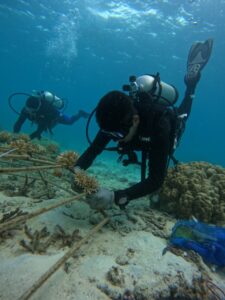
At Laguna Gili Dive Center, we have been thinking about how we can contribute to coral restoration here in Gili Trawangan.
Our plan is to develop a coral restoration project right in front of our dive center, supported through public donations. We want the project to remain open and accessible to everyone, rather than being exclusive to our guests.
More importantly, we want it to become a place where people can see and learn about coral restoration. Divers and visitors will be able to see how the structures change over time, how corals grow, and how other marine life begins to use the new habitat.
Our Next Steps
For now, our first goal is to find the right structure, materials and location for our site conditions. We will look at factors such as:
-
Depth
-
Current
-
Sediment
-
Sunlight
-
Existing reef
Once the project is installed, we will continue to monitor and maintain the site, documenting how the corals and marine life develop. Monitoring is an important part of restoration because it helps us understand whether the project is working as intended.
NOAA’s coral restoration monitoring guide provides an example of how restoration projects can be monitored and evaluated.
Combining Conservation and Education
We know that one small project cannot solve all the problems facing coral reefs. But we believe it can be a great way to combine conservation, education and community involvement.
Hopefully, when you visit us in the future, you won’t just see an artificial structure underwater.
You’ll see a reef growing around it.
Get in touch with Laguna Gili Dive Center to support coral restoration in Gili Trawangan.